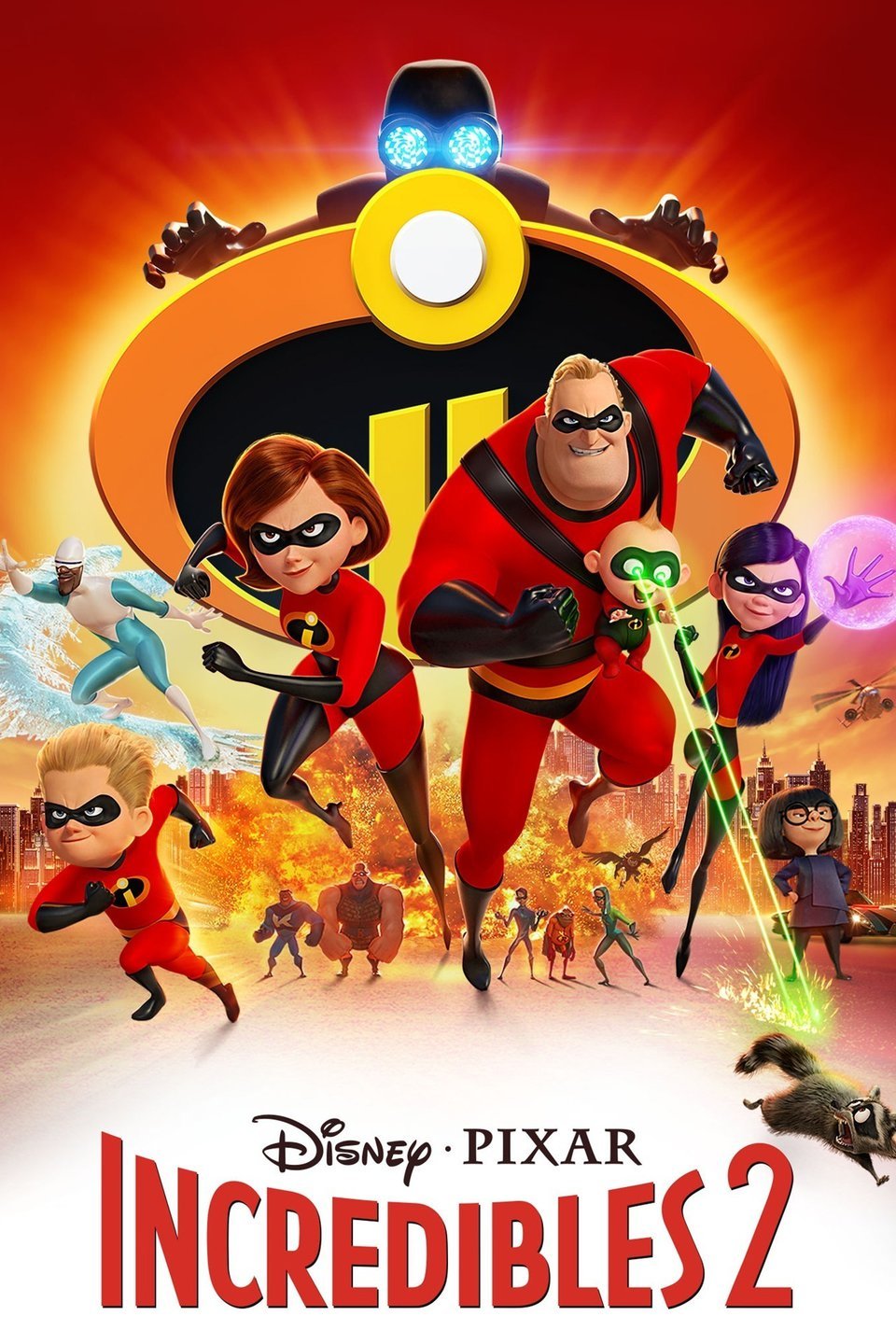
So, for my birthday yesterday I finally got around to watching The Incredibles 2. Normally, I would have watched it a lot sooner, or even gone to see it in the theater because I generally love Pixar movies. One of the things that I usually love about Pixar movies is that they are almost never about what I think they're going to be about. This one was no exception.
The reason why I didn't bother to see this one in the theater is that I saw a lot of mixed reactions claiming that the movie was "a mess" or "just dumb action" or "incoherent". No one seemed capable of identifying a central premise or theme for the movie, and a lot of people seemed disappointed.
Well, boy, did they ever miss the boat. This movie is just as tight as The Incredibles, and, in fact, it even forms a perfect symmetry with the first movie, illustrating both halves of a false dichotomy and maintaining a consistent theme between both movies, showing what is ultimately the same theme from different angles. This is an incredibly rare, almost unheard-of thing for a sequel to do. Heck, nowadays it's pretty rare for a single, stand-alone movie to have a coherent, identifiable theme that's more complex than "defeat the bad guys".
So, what is the theme? Why did everyone think that the movie is "a mess" or "incoherent"?
The theme of BOTH movies, articulated, is, "supers are just people". That's it. So simple. Everything in BOTH movies adds up to this, but taken from different angles.
In The Incredibles, superpowers are largely viewed as a bad thing, even shameful, that has to be hidden. The movie follows a family of superheroes who are in hiding. They can't be themselves, and they're struggling, depressed, and unhappy because of it. But, if you look closer, at the type of problems they have, they are just people problems. Job dissatisfaction. Trying to keep your family functioning when they're all pulling different directions. Growing up. Dating. Family squabbles. These are all regular-people problems. Heck, even when the villain is attacking the city with giant robots, the regular-people problems still take center stage.
In The Incredibles 2, it's the same overall theme, just a new set of problems and a new villain. The villain, while an emergency situation that does need to be dealt with, is not the centerpiece of the movie. The family stuff is the center of the movie. The personal problems. The stuff of daily life.
This is the inverse of your typical superhero movie, in which the point is, ultimately, always to rise to the challenge of defeating the villain, often at the cost of throwing aside or even rejecting daily life. It's interesting that in most superhero stories, this manages to (somehow) conveniently wrap up the daily life issues. Would that work in real life? Not so much. "Dropping everything" to go haring off on a mad adventure doesn't pay the bills, and there isn't usually a nice pot of gold at the end of the rainbow to conveniently solve all of your problems. In the universe of The Incredibles, the real challenge is to confront and surmount the difficulties of daily life. Only when this is accomplished can the family come together (with friends and allies) to defeat the villain.
The villains in both movies are examples of rejecting the idea that supers are just people. Both villains commit atrocities trying to one-up supers: Syndrome because he wants to drag supers down, Screenslaver because she thinks that supers are HOLDING everyone ELSE down. Both of these views are wrong, in the same way and for the same reason. Supers are just people.
What ultimately makes you a hero or a villain isn't the power you happen to have. It's the choices you make.
Book reviews, art, gaming, Objectivism and thoughts on other topics as they occur.
About Me
Showing posts with label Movie Reviews. Show all posts
Oct 27, 2018
May 6, 2015
Avengers: Age of Ultron
People have been saying a lot about this latest Marvel Cinematic Universe movie, not much of it very coherent. But then, the movie itself on first viewing is a bit incoherent. On second viewing, though, I find that my opinion has solidified:
This is a great work of art.
Oh, I know what people will say. It's cinematically flawed. The bad guy is bizarre, his motivations unclear, messy, poorly characterized. There's too much going on. It just flies at you out of nowhere. It's just a bunch of meaningless action scenes. But that is what makes it great. Because that is what the movie is about. The mess isn't random.
Avengers: Age of Ultron is about mess. About the unknown, impermanence, the inevitability of failure and death. And fighting anyway. Risking anyway. Embracing life anyway, knowing not just that it may go wrong but that it will go wrong. That there are no perfect answers, no ultimate solutions, that trouble will always come 'round again. Yet this is no excuse not to live, or to declare the whole thing not good enough and set out to smash it all.
Ultron had one thing right . . . destruction is perfect. It is pure. It is the only thing that is. And if purity and perfection are your standards, your goal, your "peace in my time" . . . then destruction is your only aim. The only realm in which evil can never happen is one in which nothing can happen.
To embrace life fully means not just to embrace happiness, but to embrace pain. To embrace the inevitability of death, of failure. You can call them your enemy, you can fight them with every part of you, but you must embrace that they exist and can never be escaped. Only by embracing their existence can you conquer them and have a chance at creating something that is majestic, glorious, transformative in its very messiness.
Like this movie.
It may not be everyone's cup of tea. But it's a great work of art.
This is a great work of art.
Oh, I know what people will say. It's cinematically flawed. The bad guy is bizarre, his motivations unclear, messy, poorly characterized. There's too much going on. It just flies at you out of nowhere. It's just a bunch of meaningless action scenes. But that is what makes it great. Because that is what the movie is about. The mess isn't random.
Avengers: Age of Ultron is about mess. About the unknown, impermanence, the inevitability of failure and death. And fighting anyway. Risking anyway. Embracing life anyway, knowing not just that it may go wrong but that it will go wrong. That there are no perfect answers, no ultimate solutions, that trouble will always come 'round again. Yet this is no excuse not to live, or to declare the whole thing not good enough and set out to smash it all.
Ultron had one thing right . . . destruction is perfect. It is pure. It is the only thing that is. And if purity and perfection are your standards, your goal, your "peace in my time" . . . then destruction is your only aim. The only realm in which evil can never happen is one in which nothing can happen.
To embrace life fully means not just to embrace happiness, but to embrace pain. To embrace the inevitability of death, of failure. You can call them your enemy, you can fight them with every part of you, but you must embrace that they exist and can never be escaped. Only by embracing their existence can you conquer them and have a chance at creating something that is majestic, glorious, transformative in its very messiness.
Like this movie.
It may not be everyone's cup of tea. But it's a great work of art.
Oct 2, 2013
Whedon Wednesday
So, I overdosed a bit on Joss Whedon yesterday so I can write about it today. The first thing I did was watch the first episode of "Agents of S.H.I.E.L.D." on Hulu, and then I rented and watched "Much Ado about Nothing". Finally, I watched the 2nd episode of AoS on ABC.
Fun times. I won't comment much about AoS apart from to say that I had fun and now I have a TV show that I am actually following. I don't watch too much TV, and series shows tend to lose my attention sometime in the 2nd season as the writers run out of invention. We'll see if this happens with AoS, but for now I'm eagerly awaiting the next episode. I will say that I just adore Clark Gregg, though. He's so adorable and has such a charming smile, particularly when he's shooting his own team with truth serum. (Watch the dang show. No more spoilers.)
That make a great segue into "Much Ado about Nothing" because Gregg plays Leonato in the movie. Actually, the entire movie is almost a Joss Whedon Reunion, having cast members from Angel, Firefly, and the Avengers in there. Alexis Denisof does a deliciously corny Benedick, although he sounds bizarre to me without the faux-English accent he had in Buffy and Angel. Or maybe the English accent is his REAL accent and the North American one is the fake? I dunno, he does both well enough that I can't tell, much like Hugh Laurie. I also loved Nathan Fillion's little cameo as Dogberry. All in all, if you like Shakespeare this is a fun modern adaptation that actually uses Shakespeare's language. So a fun time all around. Watch it.
Fun times. I won't comment much about AoS apart from to say that I had fun and now I have a TV show that I am actually following. I don't watch too much TV, and series shows tend to lose my attention sometime in the 2nd season as the writers run out of invention. We'll see if this happens with AoS, but for now I'm eagerly awaiting the next episode. I will say that I just adore Clark Gregg, though. He's so adorable and has such a charming smile, particularly when he's shooting his own team with truth serum. (Watch the dang show. No more spoilers.)
That make a great segue into "Much Ado about Nothing" because Gregg plays Leonato in the movie. Actually, the entire movie is almost a Joss Whedon Reunion, having cast members from Angel, Firefly, and the Avengers in there. Alexis Denisof does a deliciously corny Benedick, although he sounds bizarre to me without the faux-English accent he had in Buffy and Angel. Or maybe the English accent is his REAL accent and the North American one is the fake? I dunno, he does both well enough that I can't tell, much like Hugh Laurie. I also loved Nathan Fillion's little cameo as Dogberry. All in all, if you like Shakespeare this is a fun modern adaptation that actually uses Shakespeare's language. So a fun time all around. Watch it.
Sep 30, 2013
Man of Tai Chi
Click on the post title if you want more info on the movie. Anyway, I watched Man of Tai Chi a couple of days ago, and I wasn't really impressed. The whole thing just came across as really wonky and simplistic. Even the mystical Oriental-style gibberish about innocence and meditation and the purpose of martial arts was appallingly heavy-handed which kind of goes against the whole point of Oriental mysticism since it's supposed to be, you know, SUBTLE.
The fights were okay, I guess, but they were all set duels in arenas so there wasn't a whole lot interesting going on besides a ton of punching and kicking. Don't get me wrong, the fight choreography was good (as you'd expect from Yuen Woo Ping) it just wasn't particularly interesting.
Keanu Reeves also played the villain and displayed more of his classic nonexistent acting ability. He also looks really old and oddly decrepit in this film, which made the end fight between him and the hero look, well, dumb. The only really interesting fight in the entire movie is the one between the protagonist and his master, but they didn't really make much out of it.
All in all, "Man of Tai Chi" comes across more as an intentionally corny "how to produce a martial arts movie" demo than a real movie.
The fights were okay, I guess, but they were all set duels in arenas so there wasn't a whole lot interesting going on besides a ton of punching and kicking. Don't get me wrong, the fight choreography was good (as you'd expect from Yuen Woo Ping) it just wasn't particularly interesting.
Keanu Reeves also played the villain and displayed more of his classic nonexistent acting ability. He also looks really old and oddly decrepit in this film, which made the end fight between him and the hero look, well, dumb. The only really interesting fight in the entire movie is the one between the protagonist and his master, but they didn't really make much out of it.
All in all, "Man of Tai Chi" comes across more as an intentionally corny "how to produce a martial arts movie" demo than a real movie.
Jul 25, 2011
Captain America
So, first let me start out by saying that if you like superhero movies, you'll probably really enjoy Captain America. By most standards it appears to be a really good movie. I just had a terrible time getting into it, myself.
That's not to say I didn't enjoy it, I did, but the progress of the story all felt extremely wooden to me, kind of like watching Saturday Morning Cartoons where everything is telegraphed a little too much so the (presumably younger) audience can follow along. The camera just dwells way too long on things in order to let you know they're Important, and much of the dialog is delivered in a way that makes it feel too pat.
This is probably just a personal thing, but I found it irksome enough that I didn't enjoy the movie thoroughly.
Jul 23, 2011
Limitless
Adam and I watched this movie last night, and I have to say the movie I'm most strongly reminded of is No Country for Old Men. Not because they have any superficial qualities in common, but they share a self-sabotaging sort of ending that purposefully and maliciously destroys the theme of the movie and replaces it with something rather vile.
Oh, just as a quick aside before I get started pulling this thing to bits: from the trailers I honest-to-goodness thought Bradley Cooper was Jake Gyllenhaal. Now that I look them up, they don't look all that similar, but good grief how many brown-haired scruffy youngish men are there hanging about in Hollywood? Do they all have to have the same haircut? Sheesh.
The general plot of this movie at the start is not too original (more, unusual, as in you don't see it quite as often). Cooper plays Edward Morra, a down-at-the heels would-be writer who is too depressed and out-of-focus to produce anything. He is, essentially, the most stereotypical of stereotypical smart-ish loser types. Heck, I'm one myself. He lives in a crappy apartment, he's divorced, his girlfriend left him, it's all pretty pathetic.
The character/situation development is rather undercut by this whole part of the story being narrated, by the way, and the movie begins with a flash-forward scene informing you, in no uncertain terms, that Something Bad Is Going To Happen. Even the trailers weren't too coy about the basic premise of Limitless. As a result, I spent most of the movie waiting for the surprise. That's just the problem though--there isn't one.
Limitless doesn't only lack surprise, it lacks any conflict whatsoever. Time and time again, you think some sort of conflict is going to develop--Morra is going to be forced to question what he's doing and where he's going--something is going to happen. And it never does. Terrible things occur as a result of this miracle drug that turns Morra into a super-genius. Many people die, some of them at Morra's hands. Yet what happpens in the end? He outsmarts everyone and gets away free.
This is, essentially, a story of someone who magically wins the "lottery of life". At the beginning of the movie, anyone who is struggling in their life can certainly identify with Morra's situation. Yet by the end that identification and meaning are completely stripped out. I'm not a super-genius with all the money in the world and the solutions to everything. Why the heck would I root for someone who is just because he is?
The problem is that Morra never displays any *moral* characteristics. He doesn't decide to "do good" with his newfound superpowers. He doesn't decide to bring the drug to the world (even though it's revealed by the end that he's figured out how to "beat" the horrendous side effects). At the end, he's running for president, but goodness knows what kind of policies a characterless non-entity would decide to implement. It is the ultimate in Naturalist movie-making, just a series of randomish events that don't add up to anything other than, hey, I got lucky and got a hold of a big pile of money and killed some people and drank a guy's blood and whoop, I totally got away with it! Awesome!
While that might be a fun wish-fulfillment fantasy for some, it's not a story that means anything. It reminds me of the sentiment in Terry Pratchett's novel Hat Full of Sky: "In any story worth the telling, the third wish is the one that puts everything back the way it was." It is not wishing or luck or miracle drugs that get you ahead in life.
By presenting intelligence in this light--as an amoral faculty of luck and deceit--what Limitless really conveys is a profound hatred of the intellect. But this isn't the misguided yet honest hatred of a man of limited intelligence who is suspicious or envious of something he cannot have. This is a form of what Ayn Rand called "hatred of the good for being the good"--a wish, not to seize a value, but for it to cease to exist. It is a parade of anti-intellectualism wearing the trappings of the intellect, all the worse for its sheer banality.
Fortunately, due to its banality it is likely to disappear without even a ripple. At least, one can hope.
Jul 12, 2011
Faster
(As always, click the post title to go check out the Official Movie Site).
So, I watched Faster a while ago with Adam, and I have to say, the movie really surprised me. It's not even close to what I guessed it might be about. I was expecting some kind of fast-driving crime-glorifying (or at least outlaw-glorifying) action movie, but that's not what Faster is at all. It's a movie about people making horrible decisions and then trying to move on in some fashion. Yet, ultimately, they can't escape the rippling negative consequences of their decisions.
In Faster, Dwayne Johnson plays the victim of a bank job gone horribly wrong when another gang interfered. They tortured him and his brother for information, then killed his brother and nearly killed him by shooting him in the back of the head. He winds up in jail for ten years, and immediately upon release goes after the other gang for revenge, killing them one after another.
One of the things I like a lot about this movie is that it makes excellent use of the principle of Chekov's Gun--even seemingly insignificant details like the main character having a metal plate holding his skull together have their part to play in the story. I also like that revenge itself is not glorified, either, it is shown as a horrific act that, even given extreme provocation, Johnson's character has to force himself to carry out in some cases.
Most of the characters in the movie don't have names, a stylistic choice that I think works well. There's no glitz to this movie at all, no glamor, it is a straight-out tale told in the sparest way possible, a morality play of sorts. However, there's no real message here other than that actions have consequences, so it doesn't come across as some sort of syrupy public-service "take your vitamins" message film.
I think my favorite scene is about 2/3 of the way through the movie, after Driver (the only moniker given for Johnson's character) has killed a bouncer at a nightclub. The bouncer instructed Driver to call the bouncer's son on his cell phone and explain what happened. Driver does this, and then the son vows to undertake his own revenge. Driver doesn't apologize or try to make excuses, he simply says "you do what you have to do".
This declaration that the revenge is not some consequence-less act really brings home the movie for me. It strips things down to their naked essence--that this movie reviles evil as such, even when it's the "protagonist" doing the evil things. Driver is not a fully sympathetic character as a result. What he's doing *is* evil. However, he's not shown in the light of a helpless victim, either. *Everyone* in the movie chose to do what they did, and suffered for it when they chose badly.
So, despite its focus on crime, murder, and revenge, Faster is actually a benevolent movie, because it focuses on what ultimately *also* allows people to live good lives: free choice.
So, I watched Faster a while ago with Adam, and I have to say, the movie really surprised me. It's not even close to what I guessed it might be about. I was expecting some kind of fast-driving crime-glorifying (or at least outlaw-glorifying) action movie, but that's not what Faster is at all. It's a movie about people making horrible decisions and then trying to move on in some fashion. Yet, ultimately, they can't escape the rippling negative consequences of their decisions.
In Faster, Dwayne Johnson plays the victim of a bank job gone horribly wrong when another gang interfered. They tortured him and his brother for information, then killed his brother and nearly killed him by shooting him in the back of the head. He winds up in jail for ten years, and immediately upon release goes after the other gang for revenge, killing them one after another.
One of the things I like a lot about this movie is that it makes excellent use of the principle of Chekov's Gun--even seemingly insignificant details like the main character having a metal plate holding his skull together have their part to play in the story. I also like that revenge itself is not glorified, either, it is shown as a horrific act that, even given extreme provocation, Johnson's character has to force himself to carry out in some cases.
Most of the characters in the movie don't have names, a stylistic choice that I think works well. There's no glitz to this movie at all, no glamor, it is a straight-out tale told in the sparest way possible, a morality play of sorts. However, there's no real message here other than that actions have consequences, so it doesn't come across as some sort of syrupy public-service "take your vitamins" message film.
I think my favorite scene is about 2/3 of the way through the movie, after Driver (the only moniker given for Johnson's character) has killed a bouncer at a nightclub. The bouncer instructed Driver to call the bouncer's son on his cell phone and explain what happened. Driver does this, and then the son vows to undertake his own revenge. Driver doesn't apologize or try to make excuses, he simply says "you do what you have to do".
This declaration that the revenge is not some consequence-less act really brings home the movie for me. It strips things down to their naked essence--that this movie reviles evil as such, even when it's the "protagonist" doing the evil things. Driver is not a fully sympathetic character as a result. What he's doing *is* evil. However, he's not shown in the light of a helpless victim, either. *Everyone* in the movie chose to do what they did, and suffered for it when they chose badly.
So, despite its focus on crime, murder, and revenge, Faster is actually a benevolent movie, because it focuses on what ultimately *also* allows people to live good lives: free choice.
Apr 22, 2011
MovieBob on Atlas Shrugged: Part One
I think this review by MovieBob over on the Escapist is fantastic, not just because it's a very high-quality review, but also because the presence of said review on a website by, for, and about video gamers is a real demonstration of how much Ayn Rand's ideas are starting to have an effect on the culture.
Apr 17, 2011
Atlas Shrugged: Part One
This is the first movie I've seen in the theater this year. No joke. And I went to see it on opening day. Those who know me are probably already aware that I'm a big fan of Atlas Shrugged, not just as the equivalent of a "bible" of Objectivism, but because I really enjoy it as a book. So, of course, when they finally made it into a movie, I went and saw it right away. I asked my housemate if he wanted to go with me before I left, and he said, nah. He turned out to be right.
Atlas Shrugged: Part One is a train wreck.
Now, this opinion has nothing to do with the fact that it's not exactly like the book. I expected that the movie wouldn't be like the book. I HATE movies that make substantial effort to be "exactly like the book" as some sort of fanservice because this usually makes them lousy movies. Movies and novels are different art forms. What works in a novel doesn't work in a movie and vice versa. You have to take into account the nature of the medium in order to make a good movie. So I was fully prepared for even major characters to be edited out (or merged), entire plot events bypassed--all sorts of changes. I was even looking forward to them, as something new, exciting, and enjoyable.
What I wasn't expecting was the inept direction, characterization, pacing, and overall just bad moviemaking. From the moment Atlas Shrugged: Part One started to roll, I was shaking my head and rolling my eyes. I'm not talking about the casting. Most of the casting seemed reasonably appropriate and well-done. I can accept that Ellis Wyatt, who was in his mid twenties in the novel now appears to be approaching sixty. The essence of the character was reasonably well preserved.
What I can't accept was the horrible mishandling of any development of suspense or immersion. The lack of immersion is particularly egregious. This is a movie which cannot decide what world it is in. Placing it, time-wise, in 2016 was a major esthetic error from the get-go, one which even semi-competent science fiction authors know not to make. (Heck, Ayn Rand talked about this in The Art of Fiction.) Atlas Shrugged is not about any particular time period, and the effort to root it with mentions of an oil crisis in the Middle East turned it from a story about the philosophical problems of any kind of men in any kind of time into a trite modern political commentary.
From there, it only got worse. A slight miscalculation of this kind could be easily overlooked--it happens just in the first few minutes of the movie, after all. The phrase "Who is John Galt?" is done about as naturally as those radio commercials with two women doing a back-and-forth conversation about their personal problems. I was half expecting that the chosen individual uttering the phrase would turn and wink at the camera. Ayn Rand did such a wonderful job in the novel of making it a throwaway bit of slang that it was rather painful to watch.
Yet, it gets still worse. I feel like I could go on listing major errors forever. All the action (except very, very late in the movie), involves only perfectly coiffed, dressed, and made-up people in expensive clothes sitting in beautiful offices or bars or restaurants and arguing snidely with each other. This is not the way you portray a ferocious struggle with time, materials, and gross malice. Any shots that include actual machinery are completely impersonal, seen from great distance or through glass or via a news story. It is a caricature of Ayn Rand's celebration of people who really do work at the mine face where there are "no lousy jobs, only lousy men unwilling to do them". If I had only seen the movie and I was asked to give the difference between how James Taggart and Hank Rearden conduct their business, at best, all I could say was that James Taggart was a bit of a backstabber. This is not a conflict between a swollen parasite who does nothing but sit at a desk and a brilliant metallurgist who spent ten years sweating in a laboratory to produce a fantastical new product. This is a conflict between TWO men who . . . sit at desks and make snarky comments. All right then.
Then you have Rearden reminding Dagny of his anniversary party. Rearden, whose devotion to business is such that he forgot about said anniversary in the novel--repeatedly. Then you have Rearden hanging affectionately on Lillian at the party, and kissing her forehead. I could keep going in this vein, but I think I've given enough specific examples here.
I can kind of see what the director was trying to do--make the characters more "human" and accessible, doing ordinary sorts of things (like Rearden greeting Dagny cheerfully after the culmination of their roma--argh, okay, okay, I'll stop). But this completely trashes the parts of the movie which ought to be a cashing-in on the chain of established events. When Dagny and Rearden visit the 20th Century Motor Company (and Rearden just EXPLAINS what happened there ARGH ARGH NO I'M STOPPING I'M STOPPING), Dagny proceeds to throw out this line about something being a "stupid altruistic motive" and I seriously wanted to scream. They hadn't established a rationale for altruism being bad! The line completely comes out of nowhere, like those references in comic-book movies to obscure continuity events or characters. The difference being that the comic book movies don't HANG THE MOVIE on the people in the audience picking up on these obscure references and supplying all sorts of preexisting mental context. It is just plain bad. Inept. Unworthy.
Now, if you're a fan of Atlas Shrugged for the political commentary and don't know or care much about the esthetic issues here, you may actually enjoy this movie. (The theater I went to was packed, and people APPLAUDED at the end. ARGH.) There are plenty of one-liners and references in there to make you feel you're among friends and that this is a movie for "your kind of people" and invite you to feel a warm glow of belonging. But if you're actually looking to be drawn into another world, a world of stark conflicts, heroism, love, hate, reason, drama, and romance, you will be seriously disappointed. I certainly was.
And there's still more of this coming, too.
Aug 29, 2009
District 9
This movie is very unusual in that Adam didn’t like it while I actually did. Usually, if there’s any movie-disliking going on, it’s me not liking the movie while Adam kind of does. I can understand his point—if you go into District 9 expecting to be entertained in the usual style of a summer action movie, you’re not going to get much out of it. If you’re looking for your standard tale of people overcoming their differences and prejudices, you’re going to find District 9 impenetrable. Because this is not a movie about aliens and humans or even something as straightforward as racism.
It’s a movie about South Africa. Or, rather, the underlying problems that make places like South Africa what they are. It would be equally applicable in any similar place.
What District 9 does is to take a story any American would find nearly as familiar as their own bed—strangers slapped together by circumstances and forced to work together to accomplish a common goal—and uses it as a platform to rip the lid off of Hell and show it to you in a way you can actually understand. They even tell you outright the purpose of the movie very early on. The alien space ship, they say, could have stopped in New York or Tokyo or Moscow or any other famous city, but it wound up in Johannesburg. And then the fun started.
Even the style of the movie, presenting the events as newscasts and documentary footage with interviews of various distant participants mimics the only way most Westerners ever get news about Africa. Through this mechanism and the revelation of actual events, it goes on to show just how distorted, random, and ineffectual that news coverage is. Everything in the movie follows this same scheme. The brutality and callousness of all the characters, without exclusion, delivers the impression of staring into a completely foreign world where solutions for problems are the vain dreaming of distant madmen. It’s never explained why the many parties behave as strangely as they do. Counter-productive behavior isn’t an aberration here. It’s the rule.
And at the end, while there are words of hope, they are more a conceit of dreamers than anything that can really be reached or grasped. A fog of questions that will never be answered descends, leaving only one impression.
Now what?
It’s a movie about South Africa. Or, rather, the underlying problems that make places like South Africa what they are. It would be equally applicable in any similar place.
What District 9 does is to take a story any American would find nearly as familiar as their own bed—strangers slapped together by circumstances and forced to work together to accomplish a common goal—and uses it as a platform to rip the lid off of Hell and show it to you in a way you can actually understand. They even tell you outright the purpose of the movie very early on. The alien space ship, they say, could have stopped in New York or Tokyo or Moscow or any other famous city, but it wound up in Johannesburg. And then the fun started.
Even the style of the movie, presenting the events as newscasts and documentary footage with interviews of various distant participants mimics the only way most Westerners ever get news about Africa. Through this mechanism and the revelation of actual events, it goes on to show just how distorted, random, and ineffectual that news coverage is. Everything in the movie follows this same scheme. The brutality and callousness of all the characters, without exclusion, delivers the impression of staring into a completely foreign world where solutions for problems are the vain dreaming of distant madmen. It’s never explained why the many parties behave as strangely as they do. Counter-productive behavior isn’t an aberration here. It’s the rule.
And at the end, while there are words of hope, they are more a conceit of dreamers than anything that can really be reached or grasped. A fog of questions that will never be answered descends, leaving only one impression.
Now what?
Aug 13, 2009
G.I. Joe
Soooooo . . . it's not actually a bad movie. It's not great, but it's not bad, either. My biggest quibble is that I didn't like the actor they got to portray Duke (Channing Tatum, what a great name), and my main complaint was that his ears completely ruined the character for me. Yes, I'm aware that's extremely petty. Women can be shallow, too. But I had a major crush on Duke as a kid and I don't like seeing him re-imagined as a scarred charisma-less brick with two milimeters of hair and ears that make his head look like an upside-down soup bowl. This is about the worst thing they do with the source material, although I *swear* that I saw Brendan Frasier do a brief cameo as "Sergeant something-or-other" (I didn't catch the last part of the name, I thought it sounded like Slaughter, which would make him the Least Appropriate Sergeant Slaughter Ever Imagined) but he's not credited on the cast list. There are a LOT of very recognizable actors in this movie.
The rest of the movie is as campy as you might expect, but it's not awful because there's an underlying childlike glee about all the explosions, flashing lights, and ridiculous Secret Ultra-High Tech bases. Heck, even the throwaway particle scientist gets his own Ultra Cool High Tech Base even though it's only in the movie for 5 minutes. Now that's devotion to concept. They don't even work very hard at making you care about the characters. Periodically the movie remembers "oh, these people ought to have some motivations here, how do we . . . right, flashback!" and you'll get to see some snippet of a character's personal history unfold. But the movie itself seems to find these flashbacks boring and punctuates them with punching, kicking, and yet more of the beloved explosions. The scenes where you'd normally expect to hear excessive violin music of overwhelming pathos are usually drowned out by, you guessed it, explosions. It's GREAT. It's also ridiculous, particularly during the lengthy underwater aircraft battle (they really should have put that in a giant open-air cave and be done with it) that takes up maybe 1/5 of the movie.
Also, for those who are used to experiencing motion sickness in modern action flicks, don't worry. While they still did *some* photography via the "camera strapped to an excited dog" approach used in movies like The Bourne Supremacy and Batman Begins, it's much less awful and you can actually follow the action even when they're switching rapidly between three or more viewpoints. This is really helpful because otherwise the sheer quantity of action would be inducing epileptic seizures in entire audiences.
If you're looking for something intelligent, thought-provoking, or even emotionally engaging, see something else. But if you're just really in the mood to see Stuff Blowing Up, you could do worse than G.I. Joe.
The rest of the movie is as campy as you might expect, but it's not awful because there's an underlying childlike glee about all the explosions, flashing lights, and ridiculous Secret Ultra-High Tech bases. Heck, even the throwaway particle scientist gets his own Ultra Cool High Tech Base even though it's only in the movie for 5 minutes. Now that's devotion to concept. They don't even work very hard at making you care about the characters. Periodically the movie remembers "oh, these people ought to have some motivations here, how do we . . . right, flashback!" and you'll get to see some snippet of a character's personal history unfold. But the movie itself seems to find these flashbacks boring and punctuates them with punching, kicking, and yet more of the beloved explosions. The scenes where you'd normally expect to hear excessive violin music of overwhelming pathos are usually drowned out by, you guessed it, explosions. It's GREAT. It's also ridiculous, particularly during the lengthy underwater aircraft battle (they really should have put that in a giant open-air cave and be done with it) that takes up maybe 1/5 of the movie.
Also, for those who are used to experiencing motion sickness in modern action flicks, don't worry. While they still did *some* photography via the "camera strapped to an excited dog" approach used in movies like The Bourne Supremacy and Batman Begins, it's much less awful and you can actually follow the action even when they're switching rapidly between three or more viewpoints. This is really helpful because otherwise the sheer quantity of action would be inducing epileptic seizures in entire audiences.
If you're looking for something intelligent, thought-provoking, or even emotionally engaging, see something else. But if you're just really in the mood to see Stuff Blowing Up, you could do worse than G.I. Joe.
Jan 14, 2006
King Kong
I was not certain what to expect from this movie before I saw it. On the one hand, it was directed by Peter Jackson, who of all movie directors captures my sense of life most perfectly. On the other hand, though, it is a remake of an old movie I still haven't seen, and I've learned that you can't expect consistently good movies from any source. I hung back, waiting to hear from people I knew whether it was worth seeing or not.
Then I read the discussion on Oo.net about the movie and I was still more hesitant. No one really gave a distinctly positive review.
Jackson proved them wrong.
I'm sorry to say that the discussors missed the theme of this movie by about a mile. Maybe even more. What is the theme of King Kong? Masculinity.
There is only one female character in the movie, Ann Darrow, and the plot revolves around her completely, but her only purpose is to provide a contrast so that you can understand the workings of masculinity in its proper context. Without anything to compare it against, namely, femininity, the idea of masculinity is meaningless. Femininity is not explored, but simply presented as a generalization in the person of Naomi Watts' character.
Each of the different male characters embodies some aspect of masculinity; all failed or succeeded to the extent that they approached the ideal. Jack Black's character Carl Denham was the perfect archetype of drive and ambition, but his confused priorities and misunderstanding of what was really important were the ruin of everything he tried to accomplish.
Adrien Brody's Jack Driskell was the true and proper hero except for one failing: his inability to demonstrate his worth. Some quality kept him too reserved and withdrawn from the object of his desire (Ann), so she turned away from him and accepted an imperfect substitute that was more straightforward.
Captain Engleham (Thomas Kretschmann) represented a certain bloody-minded narrowly- focused competence that is generally encountered in professional career men. In his area of expertise, he was the best. The outside world took no notice of him nor him of it; he was almost a self-contained universe and thus a marginal character for all his ability.
Preston (Colin Hanks) was simply the symbol of a kind of confused innocence and honesty, but his unworldliness made him unable to even blunt the worst excesses of other characters. Jimmy (Jamie Bell) was the exemplar of reckless youth, with Evan Parke's character Hayes providing a fatherly foil.
Kyle Chandler as Bruce Banner demonstrated one of the worst and ugliest aspects of masculinity I've ever seen: narcissism. All the worse, in my opinion, because in his enchantment with himself he'd managed to convince many people that there was something under that pretty exterior. Faced with a real difficulty, however, he was forced to rely on others. And yet they continued to give him credit.
All the events of the story tie back into the idea of masculinity. I was especially pleased at how the crew of Engleham's ship moved instantly to rescue Miss Darrow when she was captured by the Skull Island savages. They didn't even question the necessity or ponder leaving her behind.
So what, exactly, did King Kong represent? He was an aspect of masculinity that goes by the simple name of The Brute, an appropriate term I picked up reading Ann Bishop's Black Jewels Trilogy. It is something about men that I have come to appreciate, if not fully understand; the deep and unstoppable passion that good men have that makes them capable of terrible and wonderful things. It is savage and can be frightening, but in general I think it's a good thing. Without that "fire in the gut", it is all too easy to lay down and die or let what is precious slip away.
All of his behavior emphasized this, from playing with Ann a bit cruelly, as though she were a toy instead of a human being (something I've seen most men do with women, so I was especially struck by it), to his pride and offended dignity after being hit in the head with a rock. Kong was so human and genuinely cute that the ending was very hard to watch indeed.
So why did Kong die? What factor conquered the magnificent brute so in love with life and with the beauty he had found? Ignorance. In his dumb incomprehension of the new and terrifying world that confronted him, he was not capable of directing his actions constructively. He could not accomplish his ends. He could only destroy them. Such was his magnificence, love, and dignity that he chose to be destroyed himself rather than allow that to happen.
I definitely recommend the movie. And, gentlemen, when you go see it, ask yourself when you return to the outside world: what sort of man am I?
Then I read the discussion on Oo.net about the movie and I was still more hesitant. No one really gave a distinctly positive review.
Jackson proved them wrong.
I'm sorry to say that the discussors missed the theme of this movie by about a mile. Maybe even more. What is the theme of King Kong? Masculinity.
There is only one female character in the movie, Ann Darrow, and the plot revolves around her completely, but her only purpose is to provide a contrast so that you can understand the workings of masculinity in its proper context. Without anything to compare it against, namely, femininity, the idea of masculinity is meaningless. Femininity is not explored, but simply presented as a generalization in the person of Naomi Watts' character.
Each of the different male characters embodies some aspect of masculinity; all failed or succeeded to the extent that they approached the ideal. Jack Black's character Carl Denham was the perfect archetype of drive and ambition, but his confused priorities and misunderstanding of what was really important were the ruin of everything he tried to accomplish.
Adrien Brody's Jack Driskell was the true and proper hero except for one failing: his inability to demonstrate his worth. Some quality kept him too reserved and withdrawn from the object of his desire (Ann), so she turned away from him and accepted an imperfect substitute that was more straightforward.
Captain Engleham (Thomas Kretschmann) represented a certain bloody-minded narrowly- focused competence that is generally encountered in professional career men. In his area of expertise, he was the best. The outside world took no notice of him nor him of it; he was almost a self-contained universe and thus a marginal character for all his ability.
Preston (Colin Hanks) was simply the symbol of a kind of confused innocence and honesty, but his unworldliness made him unable to even blunt the worst excesses of other characters. Jimmy (Jamie Bell) was the exemplar of reckless youth, with Evan Parke's character Hayes providing a fatherly foil.
Kyle Chandler as Bruce Banner demonstrated one of the worst and ugliest aspects of masculinity I've ever seen: narcissism. All the worse, in my opinion, because in his enchantment with himself he'd managed to convince many people that there was something under that pretty exterior. Faced with a real difficulty, however, he was forced to rely on others. And yet they continued to give him credit.
All the events of the story tie back into the idea of masculinity. I was especially pleased at how the crew of Engleham's ship moved instantly to rescue Miss Darrow when she was captured by the Skull Island savages. They didn't even question the necessity or ponder leaving her behind.
So what, exactly, did King Kong represent? He was an aspect of masculinity that goes by the simple name of The Brute, an appropriate term I picked up reading Ann Bishop's Black Jewels Trilogy. It is something about men that I have come to appreciate, if not fully understand; the deep and unstoppable passion that good men have that makes them capable of terrible and wonderful things. It is savage and can be frightening, but in general I think it's a good thing. Without that "fire in the gut", it is all too easy to lay down and die or let what is precious slip away.
All of his behavior emphasized this, from playing with Ann a bit cruelly, as though she were a toy instead of a human being (something I've seen most men do with women, so I was especially struck by it), to his pride and offended dignity after being hit in the head with a rock. Kong was so human and genuinely cute that the ending was very hard to watch indeed.
So why did Kong die? What factor conquered the magnificent brute so in love with life and with the beauty he had found? Ignorance. In his dumb incomprehension of the new and terrifying world that confronted him, he was not capable of directing his actions constructively. He could not accomplish his ends. He could only destroy them. Such was his magnificence, love, and dignity that he chose to be destroyed himself rather than allow that to happen.
I definitely recommend the movie. And, gentlemen, when you go see it, ask yourself when you return to the outside world: what sort of man am I?
Subscribe to:
Posts (Atom)
-
▼
2020
(4)
- ► October 2020 (1)
- ► February 2020 (1)
-
►
2019
(33)
- ► December 2019 (1)
- ► November 2019 (1)
- ► October 2019 (2)
- ► September 2019 (5)
- ► August 2019 (8)
- ► March 2019 (1)
-
►
2018
(4)
- ► December 2018 (1)
- ► October 2018 (1)
- ► February 2018 (2)
-
►
2016
(3)
- ► March 2016 (1)
- ► February 2016 (2)
-
►
2014
(26)
- ► April 2014 (3)
- ► March 2014 (2)
- ► February 2014 (3)
- ► January 2014 (7)
-
►
2013
(84)
- ► December 2013 (2)
- ► November 2013 (2)
- ► October 2013 (10)
- ► September 2013 (26)
- ► August 2013 (10)
- ► April 2013 (1)
- ► March 2013 (4)
- ► February 2013 (5)
- ► January 2013 (7)
-
►
2012
(26)
- ► December 2012 (7)
- ► November 2012 (6)
- ► April 2012 (3)
- ► January 2012 (2)
-
►
2011
(26)
- ► October 2011 (1)
- ► September 2011 (8)
- ► August 2011 (3)
- ► April 2011 (5)
- ► February 2011 (1)
-
►
2010
(2)
- ► November 2010 (1)
- ► September 2010 (1)
-
►
2009
(92)
- ► November 2009 (2)
- ► October 2009 (3)
- ► September 2009 (1)
- ► August 2009 (13)
- ► April 2009 (13)
- ► March 2009 (5)
- ► February 2009 (2)
- ► January 2009 (1)
-
►
2008
(71)
- ► December 2008 (1)
- ► November 2008 (5)
- ► October 2008 (4)
- ► September 2008 (6)
- ► August 2008 (12)
- ► April 2008 (14)
- ► March 2008 (4)
- ► February 2008 (4)
- ► January 2008 (9)
-
►
2007
(107)
- ► December 2007 (18)
- ► November 2007 (6)
- ► October 2007 (8)
- ► September 2007 (14)
- ► August 2007 (9)
- ► April 2007 (1)
- ► March 2007 (1)
- ► February 2007 (1)
- ► January 2007 (11)
-
►
2006
(177)
- ► December 2006 (3)
- ► October 2006 (1)
- ► September 2006 (4)
- ► August 2006 (8)
- ► April 2006 (17)
- ► March 2006 (32)
- ► February 2006 (35)
- ► January 2006 (30)
-
►
2005
(46)
- ► December 2005 (26)
- ► November 2005 (20)
